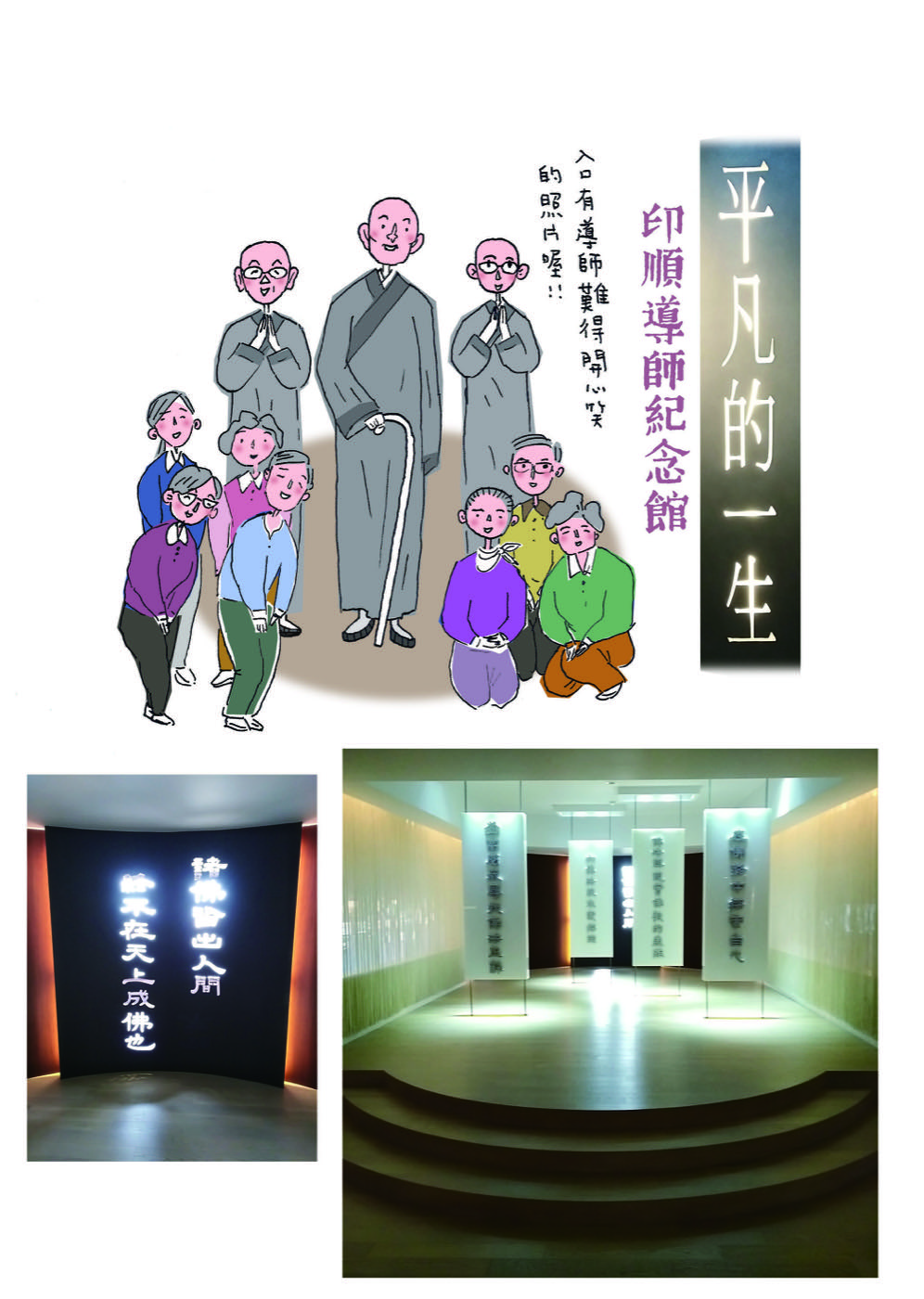
An Ordinary Life—Master Yin Shun Memorial Museum (5F)
平凡的一生——印順導師紀念館(5F)
No audio is available for this stop yet. Please read the text below.
As you enter the museum, white columns and curved exhibition walls come into view. Precious photographs and manuscripts bring to life Master Yin Shun’s great aspiration to put Humanistic Buddhism into practice. In an era of social upheaval and crisis for Buddhism, he devoted himself to a profound study of the Tripitaka, tracing the Dharma back to its origins and helping it return to its spiritual roots. In doing so, he developed a vision of Buddhism that was faithful to the Dharma while responding to the needs of the times.
Here, we invite you to explore five key stages in the Master’s life.
1. Searching for the Self on the Buddhist Path
In his youth, Master Yin Shun experienced the pain of separation and the loss of loved ones, which led him to grapple deeply with questions about the meaning of life. He searched earnestly through Confucianism, Daoism, and Christianity, but ultimately found in Buddhism a path toward liberation. He then resolutely renounced lay life and embarked on the monastic path, beginning a lifelong quest for truth.
2. The Gap Between the Dharma and Buddhism in Practice
After entering monastic life, Master Yin Shun encountered a Buddhist world increasingly centered on spirits and deities, ritual services, and abstract speculation. He was troubled by a fundamental question: Why was there such a wide gap between the Dharma he encountered in the scriptures and the Buddhism he saw in practice? This question set him on a lifelong quest to investigate Buddhism and recover the Buddha’s true teachings.
3. Studying the Buddhist Canon in Search of the True Dharma
Amid war, social upheaval, and the suffering of illness, Master Yin Shun devoted himself to studying the Buddhist canon, immersing himself in its vast collection of scriptures and treatises. Amid the rich diversity of Buddhist thought, he traced the development of Mahayana Buddhism and, through the lens of intellectual history, carefully examined and distinguished its major currents, including Madhyamaka, Yogacara, and Tathagata-garbha thought.
4. Tracing the Dharma Back to Its Origins
Master Yin Shun followed the principle of “studying Buddhism through Buddhism itself,” seeking to uncover the Dharma’s original foundations. He believed that, over the course of its long historical development, Buddhism had accumulated layers of interpretation that could obscure its original meaning. Only by tracing its development, critically examining its teachings, and carefully discerning what had been transmitted could the original spirit of the Dharma be recovered.
Through his study of the development of Indian Buddhist thought, he continually returned to its origins, determined never to lose sight of the true Dharma—to “remember the Buddha as a human being who lived and taught in this world, and to preserve the true Dharma.”
5. All Buddhas Are Born in the Human World; They Do Not Attain Buddhahood in Heaven
Master Yin Shun sought to return to the authentic spirit of the Buddha as presented in the Agamas, challenging later tendencies to mythologize and divinize the Buddha. For him, Buddhist practice must remain grounded in the human world. Through the “human practice of the Bodhisattva”—cultivating the path of benefiting others in the midst of ordinary life—one can embody the central principle that “all Buddhas are born in the human world.”
What Do You See in Master Yin Shun’s Life Journey?
“The workings of dependent origination are so real, and yet so inconceivable.” Through a single falling leaf, Master Yin Shun revealed the impermanence and vastness of life. As you reflect on his life journey, do you also see the unfolding of the karmic conditions in your own life?