Retreat Quarter
關房
No audio is available for this stop yet. Please read the text below.
The Circular Window: Boundless Compassion and Aspiration
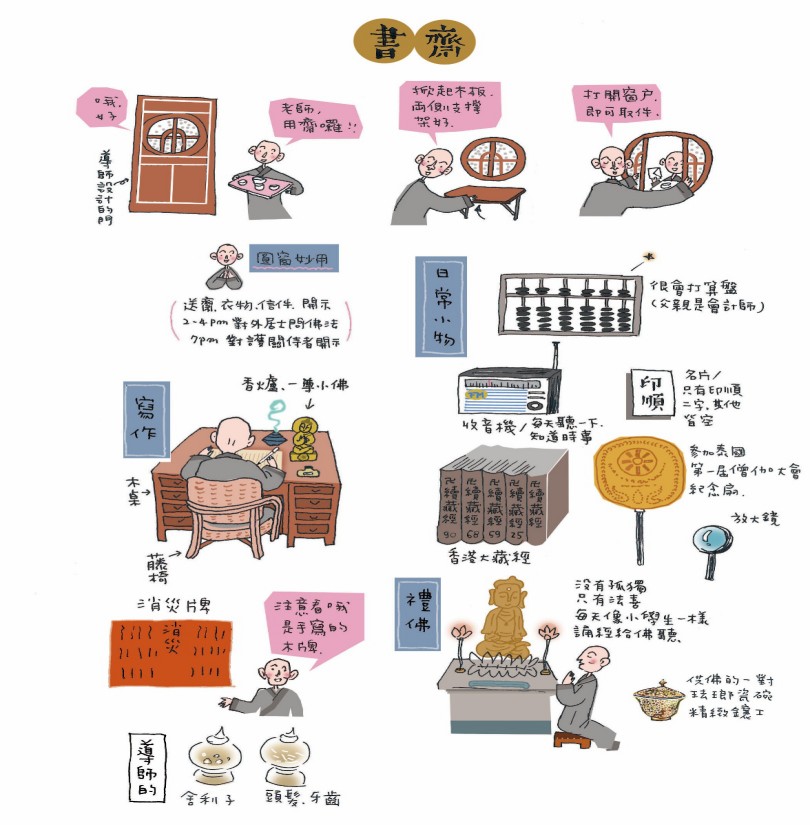
One of the most distinctive features of the retreat quarter is the circular window through which Master Yin Shun maintained contact with the outside world. During retreat, he remained within his quarters. When attendants delivered meals, supplies, or letters, they would knock gently three times as a signal.
Every evening at seven, Master Yin Shun opened the window to give teachings to his disciples. On Saturdays from two to four in the afternoon, devotees could also come to seek his guidance and ask questions. This small circular window embodies his commitment to “never forgetting sentient beings even while in retreat” and reflects the great compassionate aspiration that guided his entire life: “for Buddhism and for sentient beings.”
Immersed in the Ocean of the Dharma: Serenity and Inner Light
The Buddhist shrine inside Master Yin Shun’s retreat quarter enshrines Shakyamuni Buddha and was where he recited sutras each day. In his autobiography, Master Yin Shun recalled that when writing, he became completely immersed in the Dharma, like a student reciting and explaining a lesson before a teacher. In those quiet years, he felt no loneliness but instead experienced the joy of the Dharma.
On the desk to the right is a small tray holding a Buddha image and an incense burner. During his retreat, material resources were scarce and paper was expensive. Nevertheless, Master Yin Shun continued writing in small, meticulous characters on manuscript paper. Here, he compiled the Miaoyun Collection and completed several major works, including The Formation of the Original Buddhist Scriptures, A History of Chinese Chan Buddhism, and A Study of Ancient Chinese Ethnic Myths and Culture.
The bookcase to the left contains Master Yin Shun’s lifetime body of writings, totaling 7.5 million Chinese characters, together with the Tripitaka and numerous reference works. Nearby are his radio, watch, glasses, business cards, abacus, and other personal belongings—simple everyday objects that offer a glimpse into a life combining profound scholarship with remarkable simplicity.
A Distant Offering from Retreat: May the Lamp of Wisdom Shine Forever
Displayed on the wall is Master Yin Shun’s calligraphy of A Distant Offering from Retreat, a verse he composed upon entering retreat on May 26, 1964, the Buddha’s Birthday, to convey his thoughts to fellow Buddhists in Taiwan and abroad. The verse was later included in Fragrant Clouds and the Rain of Blossoms.
Having been a monk for thirty-five years and having spent twelve years in Taiwan, Master Yin Shun had endured many hardships, including the destruction of his writings and the need to rewrite them. Although saddened by these trials, he was even more deeply aware of the impermanence and swift passage of time. Reflecting on the hardships endured by great Buddhist masters of the past, including Paramartha and Kumarajiva, who continued to spread the Dharma despite adversity, he recognized that such difficulties had been shared by practitioners throughout history. Why, then, add further sorrow to the heart?
With his frail and impermanent body, Master Yin Shun placed his trust in the power of the Three Jewels and resolved to deepen both his understanding and practice of the Dharma for the benefit of sentient beings. Living simply and persevering day by day, he remained steadfast in his aspiration to spread the Dharma and benefit others, hoping that the Noble Path would illuminate the human world and that the true Dharma would long endure.
Living and Resting Space: Simplicity and Thoughtful Design
Master Yin Shun’s sleeping area was ingeniously separated from his bookcase by a simple wooden partition. His bed was fitted with two sliding doors covered with fine mosquito netting, allowing ventilation while keeping insects out. This modest yet thoughtful design reflects the simplicity and practical wisdom that characterized his daily life.
Daily Meals: Simple Food and a Kettle of Hot Water
During his retreat, Master Yin Shun’s daily meals consisted simply of peanuts, tofu, and vegetables. Because the same simple dishes were served day after day, they came to be jokingly known as the “Ten-Thousand-Year Vegetables.” A kettle of hot water was also kept on the table. Throughout these years of dedicated practice, Master Yin Shun lived a disciplined and simple life.
Objects on View
- ★ The circular window ★ 圓窗門
- Taiwan cypress wood building 台灣檜木建築物
- Tang-style shrine 唐朝式佛龕
- Ventilation holes 建築結構通氣孔
- The original calligraphy of “A Distant Offering from Retreat” 〈掩關遙寄〉墨寶
- Desk, personal belongings and bedroom 書桌、生活用品、臥室
- A sketch of the Master by Mr. Lu Fu Sheng, a painter 畫家呂浮生:印順導師法像素描
- Tooth relic and hair relics 牙舍利、髮舍利
- Buddhist relics (sarira) 舍利花
- A souvenir from a trip to Thailand: a fan 泰國世界僧伽會紀念扇
- A souvenir from a trip to the Philippines: a shell flower 菲律賓弘法紀念品:貝殼花
A Regular Daily Schedule
- Master Yin Shun usually woke up and began sutra chanting service at 4 am, had breakfast at 6 am, lunch at 11:30 am, dinner at 6 pm, and went to bed at 8:30 pm 清晨 4 點起板早課、6 點早齋、11 點 30 分午齋、下午 6 點藥石、晚上 8 點 30 分養息
A Distant Offering from Retreat
I have been a monk for 35 years and have stayed in Taiwan for 12 years. The turmoil and disturbance once made me downcast while the quick passing of time took me by surprise.
I hope that my poor health will be improved with the blessing of the Triratna. I also hope that my understanding of the scripture will accumulate to such a degree that other people and I can benefit and find happiness.
I will work incessantly, day after day and year after year. In the midst of the tranquility of the surroundings, I pray in silence that Buddhism will flourish and shine with great brilliance on this island in the future.
Master Yin Shun, May 26, 1964